

Fairmount Technologies’ XTRU™ Selected as Finalist in the 2026 Maritime Manufacturing Innovation Challenge
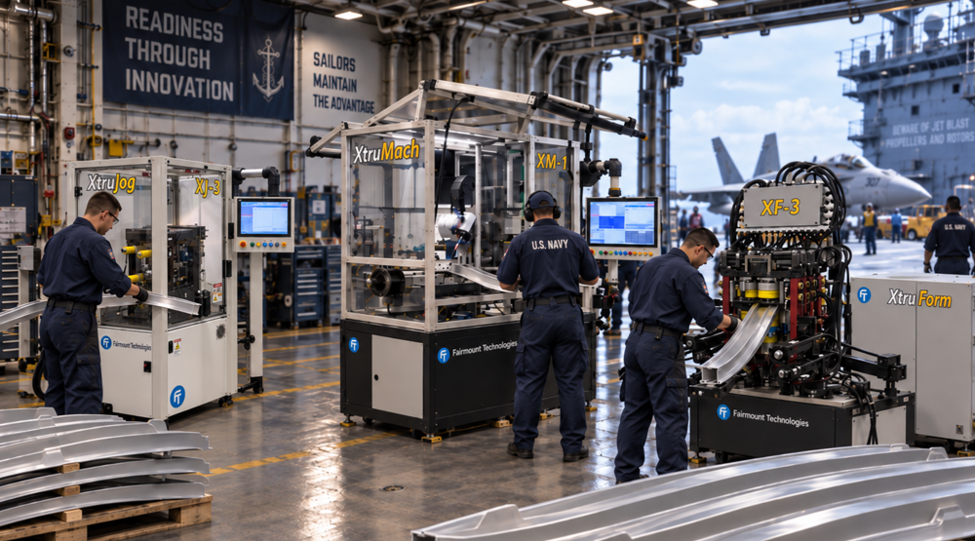
Fairmount Technologies is excited to announce that XTRU™ has been selected as a finalist in the 2026 Maritime Manufacturing Innovation Challenge, recognizing its potential to bring flexible, digitally driven manufacturing capability to the maritime industrial base.
The selection marks an important opportunity to demonstrate how technology already proven in aerospace sustainment can help address some of the most persistent challenges facing shipbuilding and maritime readiness: long tooling lead times, low-volume and high-mix part demand, constrained manufacturing capacity, complex logistics, and the need to produce critical structural components closer to the point of need.
About the Maritime Manufacturing Innovation Challenge
Launched in 2025 in response to the Executive Order to Revitalize U.S. Maritime Power, the Maritime Manufacturing Innovation Challenge brings forward emerging technologies positioned to strengthen American shipbuilding and maritime readiness.
Now entering its second year, the Challenge continues to accelerate innovation aligned with the U.S. Navy’s advanced manufacturing strategy and the broader national effort to rebuild American maritime strength.
The initiative seeks transformative technologies that can modernize shipbuilding, sustainment, maintenance, logistics, workforce capability, and industrial resilience. By connecting non-traditional innovators, advanced manufacturers, startups, defense stakeholders, and maritime leaders, the Challenge helps identify scalable solutions that can strengthen lifecycle efficiency, expand production capacity, and improve operational readiness across the maritime ecosystem.
Supporting the Transition to Distributed Shipbuilding
For many structural spare parts, the production challenge is not simply making the part—it is everything required before production can begin.
Traditional processes can depend on dedicated hard tooling that requires significant non-recurring engineering, skilled tool design and prove-out, centralized production, and associated logistics. These constraints become especially significant when requirements are low-volume, high-mix, urgent, or geographically dispersed.
XTRU is designed to change that model.
Rather than relying on dedicated tooling for each component, XTRU uses CNC-controlled machine kinematics to control part geometry through digital part programs. This allows structural components to be produced without rebuilding a part-specific tooling base every time a new requirement emerges.
The result is a manufacturing approach built around three advantages:
Lower tooling and non-recurring engineering burden. Digital part programs can replace much of the dedicated hard tooling traditionally required for structural manufacturing.
Faster repair and replication cycles. Once an approved digital manufacturing package is established, parts can be reproduced without repeating the full tooling-development process.
Production closer to the point of need. Compact, deployable manufacturing cells create the potential for distributed shipbuilding across depots, shipyards, suppliers, and other sustainment locations.
XTRU’s flow-through processes also enable the production of very long structural components, creating opportunities to reduce the number of weld stages required for certain maritime structures.
Building on a Proven Technology Base
Fairmount advanced the core capabilities through three generations of machine development and airframe part production, reaching Technology Readiness Level 8 (TRL 8). XTRU machines have been demonstrated at Warner Robins Air Logistics Complex and used in the production of thousands of structural components supporting DLA Aviation, WR-ALC, and commercial OEM applications.
Developed via Department of Defense-SBIR and RDT&E programs, XTRU is now being acquired through the WR-ALC capital acquisition program and OSW’s Accelerate the Procurement and Fielding of Innovative Technologies (APFIT) program.
This foundation provides Fairmount with a proven manufacturing platform from which to address the next challenge: adapting and scaling XTRU for maritime structural manufacturing.
From Aircraft Sustainment to Maritime Structural Production
The next stage of XTRU development focuses on translating lessons learned in aircraft sustainment to larger structures and more demanding maritime materials and applications.
Potential maritime applications include structural components such as hull and frame elements, stiffeners, brackets, decks, and hatches.
The longer-term opportunity extends beyond individual parts. XTRU can support a digital shipyard and distributed manufacturing model in which approved digital production libraries are paired with deployed manufacturing cells. Instead of duplicating dedicated tooling at every location, organizations could distribute qualified manufacturing data and produce structural components where capacity is available or where the part is needed.
Compact or containerized XTRU cells could ultimately support production across shipyards, depots, suppliers, and potentially forward or shipboard repair environments.
For the maritime industrial base, this model offers the potential to expand flexible manufacturing capacity without requiring an equivalent expansion of dedicated tooling infrastructure.
Partnering for Maritime Transition
As a Maritime Manufacturing Innovation Challenge finalist, Fairmount is seeking opportunities to work with maritime stakeholders to identify and demonstrate high-value use cases for XTRU.
The next steps include identifying appropriate shipboard, depot, or shipyard pilot environments, selecting candidate structural components, evaluating the technical developments required for larger parts and harder materials, and establishing transition pathways from pilot demonstrations to fielded manufacturing capacity.
Collaboration with shipyards, Navy organizations, depots, suppliers, and other maritime partners will be critical to identifying the applications where distributed digital manufacturing can have the greatest impact.
XTRU is ready for maritime transition—and Fairmount Technologies looks forward to working with the maritime community to help build a faster, more flexible, and more resilient manufacturing base for the future.
Learn more about the Maritime Manufacturing Innovation Challenge at Maritime Manufacturing Innovation Challenge and watch our website for updates as XTRU begins to positively impact industries outside aerospace.


Comments